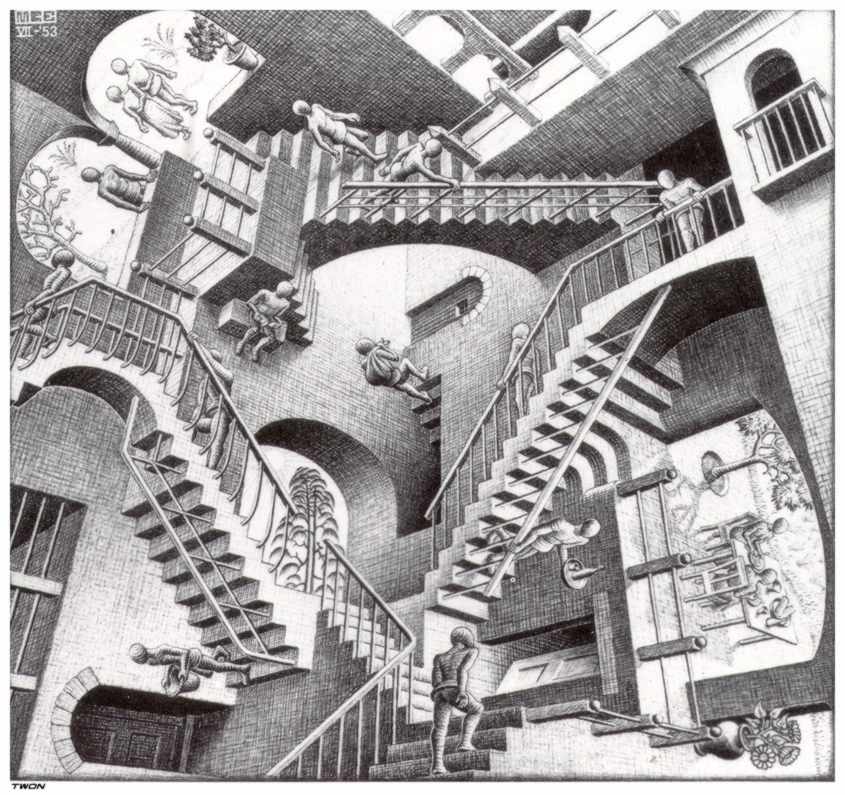
The Island of the Day Before, by Umberto Eco
1994, 517 pp.
This is the eighth book I have read by Umberto Eco, and the fourth novel. It is probably the most accessible of his fictions, though it lacks the frantic exuberance of Foucault's Pendulum.
Eco seems to have a curious habit of inventing complicated, over-educated, worldly, highly erudite characters who he then fits into rather conventional, almost dime-store plots with which he tinkers around, adding a few whimsical, slightly postmodern flourishes. The Island of the Day Before is the story of Roberto della Griva, a young Italian adventurer of the seventeenth century who finds himself shipwrecked. None of the usual Robinson Crusoe business here, though: Roberto is shipwrecked on another ship, which is abandoned (sort of) and anchored within sight of an island. Between the ship and the island runs the international date line, so the island is literally in The Day Before. The rest of the book concerns lengthy flashbacks (some 40 chapters of them, I think) explaining how Roberto ended up in this predicament, interspersed with present-day chapters on how he tries to get out of it.
The MacGuffin is the secret of longitude, which indeed was quite a difficult concept to figure out. Somewhat annoyingly, Eco subjects the reader to several long pseudo-scientific debates on this and other subjects in which people alternate spewing out several pages of peculiar seventeenth-century reasoning. Eco is persuasive at evoking the intellectual excitement of the time, when modern science was first extracting itself from the swamps of tradition, superstition, and confusion, but we never particularly get to see the beginnings of what was to become actual science, just a lot of intellectual dead-ends being tossed about. A debate between alchemy and phlogiston theory is only of limited entertainment value. These tend to wear on a bit, as does Eco's penchant for bloody-minded lists of permutations. These are a recurring event in his books, which if animated by scholarly enthusiasm (The Name of the Rose) or playful humor (Foucault's Pendulum) can be a pleasurable way to display his erudition, but can be fatal to the book if carried on in the absence of a meaningful story or interesting characters (I'm looking at you, Baudolino). Here they are not so intrusive, but are still unwelcome when they arrive.
Of course this wouldn't be an Eco book if there wasn't some rumination on the subject of narrative, an interplay of texts of questionable authenticity and veracity, and some trickery involving what is and is not fiction. At an early age Roberto conceives of an imaginary evil twin named Ferrante for whom he blames all of his life's problems. In the last third of the book, Roberto (apparently desperate for something he can control) begins to write a story in which he blames Ferrante for the circumstances which led to his voyage to the South Pacific, for stealing his lady-love, for shipwrecking him, and so forth. These work as a sort of fiction-within-a-fiction parallel to Roberto's own flashbacks. Roberto and Ferrante's back stories tend to be the most entertaining sections, sometimes accelerating into the territory of "rollicking adventure novel." There is a lengthy sequence early on about the siege of Casale, some love poems, and a mysterious sea journey. Richelieu and Mazarin have suitably villainous cameos, and there is some obligatory court intrigue to go along with it.
Eco employs his usual trope of presenting the text as a manuscript delivered to an unnamed editor who intrudes periodically in modern idiom to add humorous comment or reflection on the book's action. Eco, who seems to love nothing more than an unreliable narrator, uses this to add an extra level of doubtful veracity into a story already packed with unwise suspension of disbelief. Unfortunately, it also allows him to (wryly, mischievously) deliver a rather annoying cop-out of an ending. The litmus test of this book, precisely like all of Eco's other fiction is this: so long as the story is grounded in some semblance of reality, even a reality told in flashback or imagined in a narrative, the book works. When Eco indulges in lengthy flights of mystic fantasy or delirium, it does not. That The Island of the Day Before is two parts reality and erudition for every one part rhapsodic obscurantism is a strength. It is a solid, diverting book.
A final note is warranted in admiration for the heroic William Weaver, who has translated all of Umberto Eco's books into English, as well as piles of Italo Calvino, Roberto Calasso, Pier Paolo Pasolini, and Italo Svevo. I'm given to understand he works closely with Eco on translation, and somehow they have conceived of a process which allows them to translate words like "atrament" and "atrabilious." (Indeed, I've read the diary he kept during his year translating "Foucault's Pendulum," and experienced many a sympathetic wince as he finds himself driven to obscure dictionaries which even then do not have the peculiar words, terms, and names Eco uses...and what does one do when translating polyglot puns in dialogue of characters who constantly use foreign expressions? What about when you realize that words which are nouns in English are adjectives in Italian? The mind reels.). Any book translated by Mr. Weaver is certain to be a wealth of excellent prose, and this is no exception.
Friday, May 15, 2009

Utterly Useless Information
I have just learned that the peculiar squiggly mark favored by nineteenth century German philosophers to mark paragraphs in their impenetrable books (§) is called a "section sign," and can be vocalized in a sentence using the perfectly good English word "section." Also, the paragraph sign "¶" is called a "pilcrow" and there is a sign which combined a question mark and an exclamation point into the delightfully-named "interrobang," which this font has never even heard of. This is the best day ever.
Tuesday, May 12, 2009
Age of Iron
Age of Iron, by J.M. Coetzee
1990, 198 pp.
I had hoped to give a perfect review to J.M. Coetzee's Age of Iron, but alas, the book has one inescapable flaw: on page 141, there is a superfluous "very."
In addition to winning the Nobel Prize for Literature in 2003, Mr. Coetzee, a white South African and university professor, holds a Ph.D. in linguistics and nine honorary doctorates, translates from Dutch and Afrikaans, has won two Booker Prizes, and is such a recluse that he seems to be the only famous person on the planet who (as far as I can tell) is not a close friend of Christopher Hitchens. There are stories of entire dinner parties at which he does not utter a single word. A colleague reports having seen him laugh exactly once. I would very much like to know what the joke was. He seems to write short, stark, shocking books in tight, lapidary prose, mainly about the cruelty and suffering of living in this world. Apparently he does not smoke, drink, or eat meat; he bicycles long distances, and spends time writing seven days a week, three hundred and sixty-five days a year. I find his self-discipline and exceptional skill faintly terrifying.
Age of Iron is an epistolary novel narrated by an old woman who is dying of cancer in 1986 South Africa to her daughter in America. This is at once something of a jolt: since this is the first Coetzee book I've read, I have no idea what his authorial voice usually sounds like, but here he is never out of character. Every word is persuasively the voice of a sad, lonely, dying woman, watching the world she knew collapsing around her. Few male authors attempt a female protagonist, fewer still do so with first-person narration, and I'm not sure I've ever read anyone not only add the complications of age, terminal illness, and racial alienation, but actually succeed. To be perfectly critical, as the book goes on, the narrator (around page 150, we learn her name is Mrs. Curren) begins to give lengthy monologues which at times sound a bit stilted and are difficult to imagine actually being spoken. Mrs. Curren was a professor of classics, though, so I was willing to believe that she has a skill and familiarity with eloquent lectures, and since the narration is a letter, I assumed that in the process of writing, Mrs. Curren cleaned up the language a bit. You can almost see her revising as on page 163 when she goes from the cliché "War is never what it pretends to be. Scratch the surface and you find, invariably, old men sending young men to their death in the name of some abstraction or other" to the excellent "the future comes disguised, if it came naked we would be petrified by what we saw." Coetzee it seems is a good enough writer than he doesn't have to force Mrs. Curren to be one all the time, unlike (say), John Updike, who is always having simple, uneducated character speak with the chiseled precision of John Updike.
The book opens with Mrs. Curren discovering a homeless man named Vercueil who has been sleeping in the alley next to her house. She develops a sort of relationship with him, attempting to offer him help and charity, which he rejects, but at the same time desperately needing him for human contact. She is a smart, sensitive woman who at the end of her life has been left alone to die: "'It will be all right': those are the words I want to hear uttered. I want to be held to someone's bosom, to Florence's, to yours, to anyone's, and told that it will be all right." Vercueil is never romanticized: he is constantly difficult, unappreciative, selfish, and often unfeeling. He is mostly silent, mostly inattentive. He is, in Mrs. Curren's words, "beyond caring and beyond care." Mrs. Curren has a black live-in maid, whose teenage son gets wrapped up in anti-apartheid violence. She tries to warn him that he is too young and the police are too brutal, but his hatred is stronger than her advice: "My words fell off him like dead leaves the moment they were uttered. The words of a woman, therefore negligible; of an old woman, therefore doubling negligible; but above all of a white."
In her efforts to help the two angry teenagers, Mrs. Curren sees terrible things: police brutality, dead children, a shanty-town burning. Coetzee does not pull punches here, and is all the more harsh in that the witness to terrible events is a sad, vulnerable old woman who is constantly in pain. "Grief past weeping," she writes. "I am hollow, I am a shell. To each of us fate sends the right disease. Mine a disease that eats me out from inside. Were I to be opened up they would find me hollow as a doll, a doll with a crab sitting inside licking its lips, dazed by the flood of light."
Though the figure of Mrs. Curren is easily recognizable as a representative of soft, insulated, anti-apartheid liberal whites, neither she nor the book as a whole ever descends to the level of simple allegory. Coetzee does not force this thinking, feeling woman to become Everywoman (or Everyman), perhaps on the excellent grounds that Every(wo)man is a dreadful bore. It is an intensely personal, human book, and Coetzee never lets the reader lose track of the details of this specific person dying in this specific place at this specific time. Instead of the author making the character a hand-puppet for a larger idea, the character comes to realize her own place in the crumbling world of apartheid South Africa. She begins to witness the extent of the government capacity for brutality, and starts to understand the endless hatred that brutality has developed in the young generation. She sees terrible things, knows that more terrible things will continue to happen, and further, knows that she will not live to see peace and healing. "I am trying to keep a soul alive in times not hospitable to the soul," she writes.
Some reviews have suggested the end finds a sort of solace and salvation, but I must disagree. The relationship between Mrs. Curren and Vercueil is one of two equally marginalized people, left behind by a generation which is much harder and more cruel than they. Both of them are dead weight to a society which does not care about basic human worth, so they are left to die, ignored by everyone but each other. It's a bleak ending for a bleak book, but brilliantly crafted and flawlessly executed.
1990, 198 pp.
I had hoped to give a perfect review to J.M. Coetzee's Age of Iron, but alas, the book has one inescapable flaw: on page 141, there is a superfluous "very."
In addition to winning the Nobel Prize for Literature in 2003, Mr. Coetzee, a white South African and university professor, holds a Ph.D. in linguistics and nine honorary doctorates, translates from Dutch and Afrikaans, has won two Booker Prizes, and is such a recluse that he seems to be the only famous person on the planet who (as far as I can tell) is not a close friend of Christopher Hitchens. There are stories of entire dinner parties at which he does not utter a single word. A colleague reports having seen him laugh exactly once. I would very much like to know what the joke was. He seems to write short, stark, shocking books in tight, lapidary prose, mainly about the cruelty and suffering of living in this world. Apparently he does not smoke, drink, or eat meat; he bicycles long distances, and spends time writing seven days a week, three hundred and sixty-five days a year. I find his self-discipline and exceptional skill faintly terrifying.
Age of Iron is an epistolary novel narrated by an old woman who is dying of cancer in 1986 South Africa to her daughter in America. This is at once something of a jolt: since this is the first Coetzee book I've read, I have no idea what his authorial voice usually sounds like, but here he is never out of character. Every word is persuasively the voice of a sad, lonely, dying woman, watching the world she knew collapsing around her. Few male authors attempt a female protagonist, fewer still do so with first-person narration, and I'm not sure I've ever read anyone not only add the complications of age, terminal illness, and racial alienation, but actually succeed. To be perfectly critical, as the book goes on, the narrator (around page 150, we learn her name is Mrs. Curren) begins to give lengthy monologues which at times sound a bit stilted and are difficult to imagine actually being spoken. Mrs. Curren was a professor of classics, though, so I was willing to believe that she has a skill and familiarity with eloquent lectures, and since the narration is a letter, I assumed that in the process of writing, Mrs. Curren cleaned up the language a bit. You can almost see her revising as on page 163 when she goes from the cliché "War is never what it pretends to be. Scratch the surface and you find, invariably, old men sending young men to their death in the name of some abstraction or other" to the excellent "the future comes disguised, if it came naked we would be petrified by what we saw." Coetzee it seems is a good enough writer than he doesn't have to force Mrs. Curren to be one all the time, unlike (say), John Updike, who is always having simple, uneducated character speak with the chiseled precision of John Updike.
The book opens with Mrs. Curren discovering a homeless man named Vercueil who has been sleeping in the alley next to her house. She develops a sort of relationship with him, attempting to offer him help and charity, which he rejects, but at the same time desperately needing him for human contact. She is a smart, sensitive woman who at the end of her life has been left alone to die: "'It will be all right': those are the words I want to hear uttered. I want to be held to someone's bosom, to Florence's, to yours, to anyone's, and told that it will be all right." Vercueil is never romanticized: he is constantly difficult, unappreciative, selfish, and often unfeeling. He is mostly silent, mostly inattentive. He is, in Mrs. Curren's words, "beyond caring and beyond care." Mrs. Curren has a black live-in maid, whose teenage son gets wrapped up in anti-apartheid violence. She tries to warn him that he is too young and the police are too brutal, but his hatred is stronger than her advice: "My words fell off him like dead leaves the moment they were uttered. The words of a woman, therefore negligible; of an old woman, therefore doubling negligible; but above all of a white."
In her efforts to help the two angry teenagers, Mrs. Curren sees terrible things: police brutality, dead children, a shanty-town burning. Coetzee does not pull punches here, and is all the more harsh in that the witness to terrible events is a sad, vulnerable old woman who is constantly in pain. "Grief past weeping," she writes. "I am hollow, I am a shell. To each of us fate sends the right disease. Mine a disease that eats me out from inside. Were I to be opened up they would find me hollow as a doll, a doll with a crab sitting inside licking its lips, dazed by the flood of light."
Though the figure of Mrs. Curren is easily recognizable as a representative of soft, insulated, anti-apartheid liberal whites, neither she nor the book as a whole ever descends to the level of simple allegory. Coetzee does not force this thinking, feeling woman to become Everywoman (or Everyman), perhaps on the excellent grounds that Every(wo)man is a dreadful bore. It is an intensely personal, human book, and Coetzee never lets the reader lose track of the details of this specific person dying in this specific place at this specific time. Instead of the author making the character a hand-puppet for a larger idea, the character comes to realize her own place in the crumbling world of apartheid South Africa. She begins to witness the extent of the government capacity for brutality, and starts to understand the endless hatred that brutality has developed in the young generation. She sees terrible things, knows that more terrible things will continue to happen, and further, knows that she will not live to see peace and healing. "I am trying to keep a soul alive in times not hospitable to the soul," she writes.
Some reviews have suggested the end finds a sort of solace and salvation, but I must disagree. The relationship between Mrs. Curren and Vercueil is one of two equally marginalized people, left behind by a generation which is much harder and more cruel than they. Both of them are dead weight to a society which does not care about basic human worth, so they are left to die, ignored by everyone but each other. It's a bleak ending for a bleak book, but brilliantly crafted and flawlessly executed.
The Atrocity Exhibition
The Atrocity Exhibition, by J.G. Ballard
1970, 157 pp.
I have no idea what to make of this book. It consists of an aggregation of the so-called "condensed novels" J.G. Ballard wrote and published, mostly in New Worlds, between 1966 and 1969. These "condensed novels" are a paragraph of strange text, led off by a short, bold-faced title. At first I noted down the particularly crazy examples of these ("Transliterated Pudenda," "Eurydice in a Used-car Lot," "Dissociation: Who Laughed at Nagasaki?") but then gave up in despair. Had I continued I would have ended up transcribing the entire book. Several of these paragraphs are grouped together into a section ("The Universe of Death," "The Assassination of John Fitzgerald Kennedy Considered as a Downhill Motor Race," "The Summer Cannibals," etc.) which vaguely communicate a story. As the reader wades through these lunatic, often disturbing prose snapshots, patterns begin to emerge. There is a central figure, variously called Travis, Talbot, Traven, Tallis, Trabert, Travers--the "T-figure," if you will, apparently inspired by reclusive, mysterious novelist B. Traven. T was a bomber pilot, or imagined himself one, but was in a crash, died for a while on the operating table, and came back with "something missing." He is obsessed with finding linkages between things, mainly using visual media, and wants to re-kill John F. Kennedy in a way that "makes sense," apparently repelled, like Don DeLillo and Martin Amis, by the idea of a lonely loser meaninglessly killing the wealthy, brilliant, powerful, aristocratic Leader of the Free World. T seems to have been a doctor of some sort, and escapes from the hospital where he either worked (or was a patient), finds a woman and some radicals or sociopaths (or both) to use to hatch his plans. He is hunted by Dr. Nathan, who is either his colleague, his teacher, or his doctor, who is trying to find him, with help of Claire Austin, who is always standing by a window, and who I think was T's wife. With each new section, T's name changes, and we see similar events (a helicopter chase, flashbacks to sex and obsessive media projects, weird research, the death of a young woman, a fixation with car crashes) again and again, though slightly changed. The time is difficult to nail down: is this the same thing happening again and again, or only one event, remembered different ways? Are these things happening, or is T imagining them? Things seem to recur: I think Catherine Austin dies a half-dozen times. There is even a deplorable character named Vaughan, who may or may not be the same deplorable Vaughan of Crash, who was obsessed with the sexuality of car crashes. Ballard even took this into the real world when he staged a show of "new sculpture" at the Arts Lab in 1969, featuring three smashed cars, a topless girl, and closed-circuit television. During the month that the exhibition lasted, the cars were routinely subjected to "hostility" and attack from visitors to the gallery, and the girl was almost raped in the back set of a wrecked Pontiac.
I was at first tempted to call Ballard the most Žižekian of novelists, but considering that he began these weird stories when Žižek was about seventeen years old, it might be more accurate to call Žižek one of the most Ballardian of thinkers. There are strange mergings of inner and outer realities, such that it is impossible to determine if the external world is an application of T's psyche, or if his psyche has been determined and constructed by external inputs. There is a recurring motif of confusing landscapes with bodies: "Above all, the multistory car park was a model for her rape," for instance. The figure of Dr. Nathan is either the manifestation of postmodernism taken to its logical conclusions or a ruthless send-up of that impoverished belief system, to the extent that those two things are different. He spends a lot of time saying things like this:
"Talbot's belief--and this is confirmed by the logic of the scenario--is that automobile crashes play very different roles from the ones we assign them. Apart from its ontological function, redefining the elements of space and time in terms of our most potent consumer durable, the car crash may be perceived unconsciously as a fertilizing rather than a destructive event--a liberation of sexual energy--mediating the sexuality of those who have died with an intensity impossible in any other form: James Dean and Miss Mansfield, Camus and the late President. In the eucharist of the simulated auto-disaster we see the transliterated pudenda of Ralph Nader, our nearest image of the blood and body of Christ."
Do we?
In the last few sections of the book, the bold-face title phrases start to form disconnected sentences, which I have reproduced below in an effort to give you an indication of what the book is like to read. Generally, one gets the impression that Ballard, through all his peculiar avant-garde techniques, is on to something. Much like how Crash is borne of the observation that while car crashes are horrific in person, at a distance they become fascinating, and as entertainment are positively appealing ("The key image of the 20th century is the man in the motor car...it sums up speed, drama, aggression, the junction of advertising and technology...a car is the ultimate freedom: the freedom to kill yourself"), so too has visual media allowed the (usually male) psyche to re-create optimum sex and death acts in ways which have private meaning, rather than the absurd, meaningless character of real life. "Art," he wrote, "is the principle way in which the human mind has tried to remake the world in a way that makes sense." In terms of the structure of creation and the drive to create, whether the content of the optimum scenario is sex or death becomes immaterial, interchangeable: what matters is that it "make sense" to the person doing the constructing. The recurring images, often given in lists, tend to blend together. Here's a representative: "Pudenda of auto-crash victims. Using assembly kits constructed from photographs of (a) unidentified bodies of accident victims, (b) Cadillac exhaust assemblies, (c) the mouth-parts of Jacqueline Kennedy, volunteers were asked to devise the optimum auto-crash victim. The notional pudenda of crash victims exercised a particular fascination. Choice of subjects was as follows..." There are some eerily prescient bits: the section entitled "Why I Want to Fuck Ronald Reagan," written in 1969, suggests that images of Reagan may be the optimum mental combination of sex and violence, realized on a large scale. Ballard had quite the track record of things like this: in 1968, he predicted that eventually visual media would allow everyone to star in their own personal porn films, realizing in external images their private fantasies, in 1971 argued that personal computers would allow people to opt out of reality, and so forth.
The Atrocity Exhibition is brilliant and also almost unreadable. Few things could be less like a novel: a banana, for instance, is slightly more like a novel than The Atrocity Exhibition. It might also be brilliant. I really don't know.
Here are the combined paragraph titles. This is the closest I can come to indicating what the book is like to read. Just imagine each line is followed by a paragraph of strange, violent, sexual, obsessive text:
1970, 157 pp.
I have no idea what to make of this book. It consists of an aggregation of the so-called "condensed novels" J.G. Ballard wrote and published, mostly in New Worlds, between 1966 and 1969. These "condensed novels" are a paragraph of strange text, led off by a short, bold-faced title. At first I noted down the particularly crazy examples of these ("Transliterated Pudenda," "Eurydice in a Used-car Lot," "Dissociation: Who Laughed at Nagasaki?") but then gave up in despair. Had I continued I would have ended up transcribing the entire book. Several of these paragraphs are grouped together into a section ("The Universe of Death," "The Assassination of John Fitzgerald Kennedy Considered as a Downhill Motor Race," "The Summer Cannibals," etc.) which vaguely communicate a story. As the reader wades through these lunatic, often disturbing prose snapshots, patterns begin to emerge. There is a central figure, variously called Travis, Talbot, Traven, Tallis, Trabert, Travers--the "T-figure," if you will, apparently inspired by reclusive, mysterious novelist B. Traven. T was a bomber pilot, or imagined himself one, but was in a crash, died for a while on the operating table, and came back with "something missing." He is obsessed with finding linkages between things, mainly using visual media, and wants to re-kill John F. Kennedy in a way that "makes sense," apparently repelled, like Don DeLillo and Martin Amis, by the idea of a lonely loser meaninglessly killing the wealthy, brilliant, powerful, aristocratic Leader of the Free World. T seems to have been a doctor of some sort, and escapes from the hospital where he either worked (or was a patient), finds a woman and some radicals or sociopaths (or both) to use to hatch his plans. He is hunted by Dr. Nathan, who is either his colleague, his teacher, or his doctor, who is trying to find him, with help of Claire Austin, who is always standing by a window, and who I think was T's wife. With each new section, T's name changes, and we see similar events (a helicopter chase, flashbacks to sex and obsessive media projects, weird research, the death of a young woman, a fixation with car crashes) again and again, though slightly changed. The time is difficult to nail down: is this the same thing happening again and again, or only one event, remembered different ways? Are these things happening, or is T imagining them? Things seem to recur: I think Catherine Austin dies a half-dozen times. There is even a deplorable character named Vaughan, who may or may not be the same deplorable Vaughan of Crash, who was obsessed with the sexuality of car crashes. Ballard even took this into the real world when he staged a show of "new sculpture" at the Arts Lab in 1969, featuring three smashed cars, a topless girl, and closed-circuit television. During the month that the exhibition lasted, the cars were routinely subjected to "hostility" and attack from visitors to the gallery, and the girl was almost raped in the back set of a wrecked Pontiac.
I was at first tempted to call Ballard the most Žižekian of novelists, but considering that he began these weird stories when Žižek was about seventeen years old, it might be more accurate to call Žižek one of the most Ballardian of thinkers. There are strange mergings of inner and outer realities, such that it is impossible to determine if the external world is an application of T's psyche, or if his psyche has been determined and constructed by external inputs. There is a recurring motif of confusing landscapes with bodies: "Above all, the multistory car park was a model for her rape," for instance. The figure of Dr. Nathan is either the manifestation of postmodernism taken to its logical conclusions or a ruthless send-up of that impoverished belief system, to the extent that those two things are different. He spends a lot of time saying things like this:
"Talbot's belief--and this is confirmed by the logic of the scenario--is that automobile crashes play very different roles from the ones we assign them. Apart from its ontological function, redefining the elements of space and time in terms of our most potent consumer durable, the car crash may be perceived unconsciously as a fertilizing rather than a destructive event--a liberation of sexual energy--mediating the sexuality of those who have died with an intensity impossible in any other form: James Dean and Miss Mansfield, Camus and the late President. In the eucharist of the simulated auto-disaster we see the transliterated pudenda of Ralph Nader, our nearest image of the blood and body of Christ."
Do we?
In the last few sections of the book, the bold-face title phrases start to form disconnected sentences, which I have reproduced below in an effort to give you an indication of what the book is like to read. Generally, one gets the impression that Ballard, through all his peculiar avant-garde techniques, is on to something. Much like how Crash is borne of the observation that while car crashes are horrific in person, at a distance they become fascinating, and as entertainment are positively appealing ("The key image of the 20th century is the man in the motor car...it sums up speed, drama, aggression, the junction of advertising and technology...a car is the ultimate freedom: the freedom to kill yourself"), so too has visual media allowed the (usually male) psyche to re-create optimum sex and death acts in ways which have private meaning, rather than the absurd, meaningless character of real life. "Art," he wrote, "is the principle way in which the human mind has tried to remake the world in a way that makes sense." In terms of the structure of creation and the drive to create, whether the content of the optimum scenario is sex or death becomes immaterial, interchangeable: what matters is that it "make sense" to the person doing the constructing. The recurring images, often given in lists, tend to blend together. Here's a representative: "Pudenda of auto-crash victims. Using assembly kits constructed from photographs of (a) unidentified bodies of accident victims, (b) Cadillac exhaust assemblies, (c) the mouth-parts of Jacqueline Kennedy, volunteers were asked to devise the optimum auto-crash victim. The notional pudenda of crash victims exercised a particular fascination. Choice of subjects was as follows..." There are some eerily prescient bits: the section entitled "Why I Want to Fuck Ronald Reagan," written in 1969, suggests that images of Reagan may be the optimum mental combination of sex and violence, realized on a large scale. Ballard had quite the track record of things like this: in 1968, he predicted that eventually visual media would allow everyone to star in their own personal porn films, realizing in external images their private fantasies, in 1971 argued that personal computers would allow people to opt out of reality, and so forth.
The Atrocity Exhibition is brilliant and also almost unreadable. Few things could be less like a novel: a banana, for instance, is slightly more like a novel than The Atrocity Exhibition. It might also be brilliant. I really don't know.
Here are the combined paragraph titles. This is the closest I can come to indicating what the book is like to read. Just imagine each line is followed by a paragraph of strange, violent, sexual, obsessive text:
In his dream of Zapruder frame 235
Tallis was increasingly preoccupied
by the figure of the President's wife.
The planes of her face, like the
cars of the abandoned motorcade
mediated to him the complete silence
of the plaza, the geometry of murder.
At night, these visions of helicopters and the D.M.Z.
fused in Traven's mind with the spectre
of his daughter's body. The lantern of her face
hung among the corridors of sleep.
Warning him, she summoned to her side
all the legions of the bereaved.
By day the overflights of B.52s
crossed the drowned causeways of the delta,
unique ciphers of violence and desire.
Each afternoon in the deserted cinema
Tallis was increasingly distressed
by the images of colliding motor cars.
Celebrations of his wife's death,
the slow-motion newsreels
recapitulated all his memories of childhood,
the realization of dreams
which even during the safe immobility of sleep
would develop into nightmares of anxiety.
Tallis was increasingly preoccupied
by the figure of the President's wife.
The planes of her face, like the
cars of the abandoned motorcade
mediated to him the complete silence
of the plaza, the geometry of murder.
At night, these visions of helicopters and the D.M.Z.
fused in Traven's mind with the spectre
of his daughter's body. The lantern of her face
hung among the corridors of sleep.
Warning him, she summoned to her side
all the legions of the bereaved.
By day the overflights of B.52s
crossed the drowned causeways of the delta,
unique ciphers of violence and desire.
Each afternoon in the deserted cinema
Tallis was increasingly distressed
by the images of colliding motor cars.
Celebrations of his wife's death,
the slow-motion newsreels
recapitulated all his memories of childhood,
the realization of dreams
which even during the safe immobility of sleep
would develop into nightmares of anxiety.
Thursday, May 7, 2009
Vermilion Sands
Vermilion Sands, by J.G. Ballard
1971, 208 pp.
As I was writing my review of Ballard's The Burning World, I did a quick New York Times search to see what his most recent book was. Instead I saw that he had died the day before. I admit I was a bit taken aback: I'd liked the book and looked forward to reading more of his stuff. I remembered reading that China Miéville considered Ballard one of his heroes, that Kingsley Amis was a big fan, and that Anthony Burgess wrote a few glowing reviews of Ballard's early books. I read a half-dozen or so appreciations in The Guardian and went back and re-read the half-dozen reviews Martin Amis wrote of his work. I came away regretting that I'd only gotten round to reading him so late, and resolved to be better acquainted with his body of work.
To that end I picked up his short story collection Vermilion Sands. It is always mentioned in one breath among his greatest work, and among the greatest work in the genre, so I felt on solid ground. I was not disappointed; nor, in the interest of disclosure, was I astounded. Instead I finished the book as intrigued as I was when I began it.
Vermilion Sands is a collection of nine stories, all vaguely connected by character and location, but inextricably connected in mood and theme. All of them take place in a sort of run-down future Palm Springs equivalent called "Vermilion Sands," which seems to be on the shore of an ocean made of shifting, dangerous sand where white manta rays fly around in the sky. There are mentions of something called "the Recess," a time when apparently everyone on Earth took a decade off from work and productivity. Vermilion Sands is populated by the idle rich, particularly the idle rich as envisioned from the vantage point of the mid-1960's: these are not unemployed stockbrokers or venture capitalists, but avant-garde artists and mysterious actors. Each story revolves around some sort of futuristic art medium: psychologically sensitive architecture, flowers that produce sound instead of smell, singing statues, moving painted screens, cloud sculptures, living fabric, paintings that remember what they see, and automated poetry computers. Each story is told via first-person narrator, usually a professional artist, who encounters a demented, listless, dangerous woman. These women tend to wear billowing white gowns over their naked bodies, often are rich or formerly famous, usually live in abandoned villas, have mysterious pasts, and frequently are obsessed with a dead person. Often the art medium in question goes terribly wrong or turns out to be dangerous.
The earliest story is "Prima Belladonna," first published in 1956, the latest is "Say Goodbye to the World," from 1970. All of these stories are slathered in the aesthetic of the old New Worlds science fiction magazine during its run under the guidance of Michael Moorcock and M. John Harrison. New Worlds brought together a collection of avant-garde, speculative, so-called "new wave" writers, mainly anarchists and socialists by nature, who were interested in William S. Burroughs, psychedelic drugs, sexual liberation, and the decay of Western Civilization. They printed a lot of MC Escher art and Beat poetry. Here's a mission-statement excerpt from one of their many defenses of their freedom to publish: "Tired of the familiar hypocrisies and the empty moralising of the middle-class, bored with the sententious orthodoxy of the official Left, suspicious of the motives of big business, especially the arms trade, hearing the first intimations of a very noisy uncontrollable cyberspace, a virtual universe of spin and image manipulation, understanding how popular media can become a sinister instrument of public brainwashing, how easily the culture of consumerism buys and sells our representatives..."
Marshall McLuhan's ideas were manifest (though sometimes excoriated) on almost every page, as they are in Vermilion Sands as well: there is all manner of concern over the implications of a medium, on the degrees of participation demanded of a consumer of that medium, and the potential evolution of our continued detachment from media and disinterest in actual experiences. I love the stuff these guys wrote. It's weird, often profane, frequently mind-bending, but subversive, interrogative, and instigative in a way that I think only science fiction can be and in the way I think science fiction ought to be. M. John Harrison is still one of my favorite writers of all time, and perhaps the finest prose stylist currently working in English. Gene Wolfe is some kind of demented genius. Michael Moorcock is the dean of aggressive, anarchist, anti-heroic, counter-culture fantastic fiction. I even like Harlan Ellison's early stories. I've never made it anywhere into Samuel Delaney, though. Ballard was frequently in New Worlds, especially his "condensed novels," which were later aggregated into The Atrocity Exhibition, a savage bit of madness I'm also currently reading.
New Worlds got in rather a lot of trouble when they decided to serialize a novel called Bug Jack Barron by Norman Spinrad which was morally, verbally, and thematically explicit in rather inventive ways. It also featured the excellent line, "The saddest day of your life isn't when you decide to sell out. The saddest day of your life is when you decide to sell out and nobody wants to buy."
I digress. Here Ballard's stories are somewhat leisurely and restrained, and admittedly seem to be hitting the same note over and over. As ever, he is strong with the peculiar visual simile. For instance: "His dead clothes hung on his muscular body like the husk of some violated fruit." Or "Her skin dimmed and the insects in her eyes slowed to a delicate waving." At times he lets his characters, who are intelligent, though gripped with unconquerable ennui, reflect and philosophize. At this the story "Studio 5, the Stars" is certainly the strongest. It concerns a future in which poetry is produced by automated machines that are programmed with rhyme schemes, assonances, themes, and so forth. Poets are incapable of writing their own work, instead their "art" comes from how well they can program their poetry computers. "Fifty years ago," a character says, "a few people wrote poetry, but no one read it. Now no one writes it either. The VT set merely simplifies the whole process." To these people "great literature is not only unreadable, but unwriteable as well." The medium really has become the message.
Vermilion Sands is an interesting read, particularly as a sort of time capsule, though I feel it would have benefited from some variation. By the last story, the reader knows precisely what is going to happen and when, which is too bad because each story individually is quite worthy of consideration. I will report back when and if I survive reading The Atrocity Exhibition.
1971, 208 pp.
As I was writing my review of Ballard's The Burning World, I did a quick New York Times search to see what his most recent book was. Instead I saw that he had died the day before. I admit I was a bit taken aback: I'd liked the book and looked forward to reading more of his stuff. I remembered reading that China Miéville considered Ballard one of his heroes, that Kingsley Amis was a big fan, and that Anthony Burgess wrote a few glowing reviews of Ballard's early books. I read a half-dozen or so appreciations in The Guardian and went back and re-read the half-dozen reviews Martin Amis wrote of his work. I came away regretting that I'd only gotten round to reading him so late, and resolved to be better acquainted with his body of work.
To that end I picked up his short story collection Vermilion Sands. It is always mentioned in one breath among his greatest work, and among the greatest work in the genre, so I felt on solid ground. I was not disappointed; nor, in the interest of disclosure, was I astounded. Instead I finished the book as intrigued as I was when I began it.
Vermilion Sands is a collection of nine stories, all vaguely connected by character and location, but inextricably connected in mood and theme. All of them take place in a sort of run-down future Palm Springs equivalent called "Vermilion Sands," which seems to be on the shore of an ocean made of shifting, dangerous sand where white manta rays fly around in the sky. There are mentions of something called "the Recess," a time when apparently everyone on Earth took a decade off from work and productivity. Vermilion Sands is populated by the idle rich, particularly the idle rich as envisioned from the vantage point of the mid-1960's: these are not unemployed stockbrokers or venture capitalists, but avant-garde artists and mysterious actors. Each story revolves around some sort of futuristic art medium: psychologically sensitive architecture, flowers that produce sound instead of smell, singing statues, moving painted screens, cloud sculptures, living fabric, paintings that remember what they see, and automated poetry computers. Each story is told via first-person narrator, usually a professional artist, who encounters a demented, listless, dangerous woman. These women tend to wear billowing white gowns over their naked bodies, often are rich or formerly famous, usually live in abandoned villas, have mysterious pasts, and frequently are obsessed with a dead person. Often the art medium in question goes terribly wrong or turns out to be dangerous.
The earliest story is "Prima Belladonna," first published in 1956, the latest is "Say Goodbye to the World," from 1970. All of these stories are slathered in the aesthetic of the old New Worlds science fiction magazine during its run under the guidance of Michael Moorcock and M. John Harrison. New Worlds brought together a collection of avant-garde, speculative, so-called "new wave" writers, mainly anarchists and socialists by nature, who were interested in William S. Burroughs, psychedelic drugs, sexual liberation, and the decay of Western Civilization. They printed a lot of MC Escher art and Beat poetry. Here's a mission-statement excerpt from one of their many defenses of their freedom to publish: "Tired of the familiar hypocrisies and the empty moralising of the middle-class, bored with the sententious orthodoxy of the official Left, suspicious of the motives of big business, especially the arms trade, hearing the first intimations of a very noisy uncontrollable cyberspace, a virtual universe of spin and image manipulation, understanding how popular media can become a sinister instrument of public brainwashing, how easily the culture of consumerism buys and sells our representatives..."
Marshall McLuhan's ideas were manifest (though sometimes excoriated) on almost every page, as they are in Vermilion Sands as well: there is all manner of concern over the implications of a medium, on the degrees of participation demanded of a consumer of that medium, and the potential evolution of our continued detachment from media and disinterest in actual experiences. I love the stuff these guys wrote. It's weird, often profane, frequently mind-bending, but subversive, interrogative, and instigative in a way that I think only science fiction can be and in the way I think science fiction ought to be. M. John Harrison is still one of my favorite writers of all time, and perhaps the finest prose stylist currently working in English. Gene Wolfe is some kind of demented genius. Michael Moorcock is the dean of aggressive, anarchist, anti-heroic, counter-culture fantastic fiction. I even like Harlan Ellison's early stories. I've never made it anywhere into Samuel Delaney, though. Ballard was frequently in New Worlds, especially his "condensed novels," which were later aggregated into The Atrocity Exhibition, a savage bit of madness I'm also currently reading.
New Worlds got in rather a lot of trouble when they decided to serialize a novel called Bug Jack Barron by Norman Spinrad which was morally, verbally, and thematically explicit in rather inventive ways. It also featured the excellent line, "The saddest day of your life isn't when you decide to sell out. The saddest day of your life is when you decide to sell out and nobody wants to buy."
I digress. Here Ballard's stories are somewhat leisurely and restrained, and admittedly seem to be hitting the same note over and over. As ever, he is strong with the peculiar visual simile. For instance: "His dead clothes hung on his muscular body like the husk of some violated fruit." Or "Her skin dimmed and the insects in her eyes slowed to a delicate waving." At times he lets his characters, who are intelligent, though gripped with unconquerable ennui, reflect and philosophize. At this the story "Studio 5, the Stars" is certainly the strongest. It concerns a future in which poetry is produced by automated machines that are programmed with rhyme schemes, assonances, themes, and so forth. Poets are incapable of writing their own work, instead their "art" comes from how well they can program their poetry computers. "Fifty years ago," a character says, "a few people wrote poetry, but no one read it. Now no one writes it either. The VT set merely simplifies the whole process." To these people "great literature is not only unreadable, but unwriteable as well." The medium really has become the message.
Vermilion Sands is an interesting read, particularly as a sort of time capsule, though I feel it would have benefited from some variation. By the last story, the reader knows precisely what is going to happen and when, which is too bad because each story individually is quite worthy of consideration. I will report back when and if I survive reading The Atrocity Exhibition.
Sunday, May 3, 2009
The Sheltering Sky
The Sheltering Sky, by Paul Bowles
1949, 335 pp.
When I began mentally composing this review, it was going to be "appreciative" and "positive," though well short of "glowing," but now that I'm sitting down to physically write it, having now finished the book and had time to think about it, I must admit I've quite changed my mind.
The Sheltering Sky involves an unhappily married American couple unfortunately named “Port” and “Kit” (fun fact: the guy’s full name is “Port Moresby,” which is the same name as the capital of Papua New Guinea!) as they and sometimes their friend Tunner travel aimlessly around North Africa shortly after the Second World War. They frequently encounter the Lyles, a pair of despicable and disreputable Brits also meandering around the fringes of the Sahara. None of them are particularly appealing characters: Port, who gets the majority of the third-person subjective narrative attention, alternates between vague, moody, pseudo-mystical drifting and cynical manipulation. If he isn't sitting around staring profoundly at the desert, he's probably wandering off to some encounter involving a prostitute. Kit is a solipsist hypochondriac, which may be redundant but is unfortunately accurate, who spends a lot of time whining and fretting. She is obsessed with omens. She seems pretty clearly manic-depressive, and is (for reasons to be shortly explained) the book's unredeemable flaw. Tunner is a bit of a dunce and is easily manipulated, and early on manages to get Kit drunk on a train and has sex with her. Now, I am all in favor of amoral, complicated, conflicted, or otherwise interesting characters. I do not by any means demand that characters be good people, and indeed of the various elements in fiction, character might be the one which interests me least. But I didn't believe any of these people. The minor characters are excellently drawn, and the environment is clear and lovely. But the center of the book does not hold.
There is hardly any plot to speak of, aside from the basic, primal, Campbellian "journey away from civilization." I assimilated this theme gladly, and for the first two thirds of the book was perfectly happy with it. I processed the idea that Port was stripping away the accoutrements of modern life, and in doing so was stripping away the pieces of the self, and was negligently destroying his wife in the process. So far so good, a sort of Thoreau/ St. Simeon Stylites, but with a modern recognition of the torment of interpersonal relations. It is never established where this drive for self-destruction comes from, but I was willing to take it as given, even in spite of his pensive moping and silly behavior. Recognizing the context of post-war, existential, French-influenced, Beat-era gestalt, I was content to run with the unexplained, slightly archetypal despair and flight from civilization. The motif of the Sahara as a vast, morally nihilist, unfeeling, uncaring, but pure and natural counterpoint to the moral and aesthetic horrors of civilization worked perfectly well. But then at the end of Part II, he gets typhoid and dies in a fit of delirium, mainly because he can't really be bothered to get better. Kit, sought by the local police, escapes alone into the desert. All right, I thought, he's managed to destroy himself, and now she's picking it up and pushing on with her own journey. This, I decided, will be the real test of the novel.
And then the whole damn thing goes right off the rails. Kit gets picked up by a caravan of Arabs, one of whom shortly thereafter (in a fit of vague, flowery, slightly delirious prose) rapes her and then shares her with another nomad. She rather likes this, and becomes his regular concubine. When they reach his home, he dresses her as an Arab boy and keeps her locked in a room as a sort of drugged sex slave. Then his wives find out and they whip her until he rescues her and then (I think) decides to kill her via slow poisoning. She escapes and wanders aimlessly in a market until she gets picked up by an apparently beautiful black guy, who she promptly has sex with in a hotel he finds. She wakes up to discover him and the hotelier stealing her money. Finally people from the embassy track her down and send her (struggling, unwilling) back to Tangier. Tunner turns up to meet her, but she disappears into the city. End of book.
Does that last paragraph make the slightest bit of sense to you? Does it fit with the previous ones? Does it sound like I made it up? More importantly, do you think any human being at all ever anywhere would behave that way?
Oh, how heroically I struggled to drag a meaningful theme out of this book! Perhaps, I reasoned, this book is about sheltered Europe coming face-to-face with The Other. Here Africa kills a white man and has sex with a white woman. Quelle horreur! But the last third fits so poorly with the rest that genuinely I expected to turn every page and find that it was all just a dream. Since it obviously involves Kit losing her mind, how much of it actually happened? How much did she imagine or hallucinate, aided by the third-person subjective narrative choice? Alas, it all appears to be quite literal. Maybe, I thought, it's about the inability of the West to appreciate, understand, and eventually survive their encounter with Blackest Africa: sort of an "East is East, West is West, and never the twain shall meet" idea. The frail, man-made "truths" of the West meet the ancient, indifferent actuality of the natural world, right? But symbolism only goes so far. A character must still be a recognizable human being and must behave according to some semblance of internal logic. A character is the medium for a sort of relationship between the reader and the author in which the reader gives attention and hopefully emotional and/or intellectual engagement, and the author promises not to betray the reader's trust. It is a great paradox of fiction that despite being nothing but lies, it must also scrupulously tell the truth. And I didn't believe anything the last third: it breaks the reader-author relation established in the first two sections.
I wanted some explanation, so I turned to the film, made in 1990 by Bernardo Bertolucci, that rather self-indulgent poet of sensual images, lonely sex, and loss. Most of the film is quite literally shot-by-shot, word-for-word from the book, but without the third-person subjective narration. I found the sumptuous cinematography by Vittorio Storaro a pleasure to watch, but with the absence of the novel's inner reflection, the dialogue is stilted and the interpersonal action a bit abrupt and poorly fleshed out. This absence of internal narrative both taketh and giveth back: on the one hand, we miss the emotions and obsessions which (slightly) explain the characters' peculiar or otherwise unmotivated behavior. Without this, they occasionally just appear to be behaving stupidly for no reason at all. On the other hand, we are also spared some of the rambling delusional passages, which helps. Without the narrative demonstration of Kit's apparent descent into lunacy, the last third in particular seems rather ridiculous, for the very good reason that it is rather ridiculous. Some of the more sensational bits, especially towards the end, are toned down for the film. Apparently Bertolucci actually spoke with some North Africans while filming and discovered that it isn’t precisely common behavior to appropriate a bewildered white woman as a sex slave, so the sexual experiences at the end are softened and made slightly more logical. Bowles was apparently infuriated by this, and said later in an interview “it should never have been filmed. The ending is idiotic and the rest is pretty bad.”
As in the novel, the supporting characters are the strong point. The actors who play the Lyles are slimy and deplorable almost to the point of caricature. Their appearances and some of the interplay between Kit and Port which in the novel seemed to be expressions of listless, existential ennui instead accelerate into the realm of comedy. As ever, I quite disliked John Malkovich. He does some strong acting here, but not even that can disguise his faintly crossed eyes and peculiarly affected voice.
In the film, the central characters appear more as wealthy Gatsby-ish dilettantes, whereas in the novel, they seemed more like slightly scruffy permanent expats. This suggests that the barrier which separates the travelers from their surroundings is less their skin color and origin and more their wealth. Partially since there is no major African character, and the narration given to Tunner and the occasional French officer is missing in the film, so there is no counterpoint to emphasize their Otherness. Instead we just see them floating through crowds of impoverished, fly-covered children, tossing money around. The story seems much more like "spoiled rich people encounter realities of poverty and go crazy or die" instead of "in search of meaning, pointless people encounter indifference of the world and go crazy or die," which is what I choose to believe I got from the novel. The film is in general a more presentable, restrained piece, and in my estimation works better than the novel, but the end is still a mess.
In an interesting touch, Paul Bowles himself turns up as the narrator: an elderly, well-dressed fellow, sitting at the back of cafes, watching the main characters. Unfortunately, Mr. Bowles' diction is slurred and muddy. He is an interesting presence, but at 79 years old, not an ideal narrator. The Sheltering Sky was his first novel, written when he was 38 and was forming the focal point of the weird expatriate artist community in Tangier which would shortly include William S. Burroughs, Gregory Corso, Jack Kerouac, and Tennessee Williams. I like the work of his contemporaries and generally trust their recommendations; indeed, Bowles is generally highly regarded, but it must be by those who either started this book and did not finish it, or who were blessed with the ability to forget how it ends.
1949, 335 pp.
When I began mentally composing this review, it was going to be "appreciative" and "positive," though well short of "glowing," but now that I'm sitting down to physically write it, having now finished the book and had time to think about it, I must admit I've quite changed my mind.
The Sheltering Sky involves an unhappily married American couple unfortunately named “Port” and “Kit” (fun fact: the guy’s full name is “Port Moresby,” which is the same name as the capital of Papua New Guinea!) as they and sometimes their friend Tunner travel aimlessly around North Africa shortly after the Second World War. They frequently encounter the Lyles, a pair of despicable and disreputable Brits also meandering around the fringes of the Sahara. None of them are particularly appealing characters: Port, who gets the majority of the third-person subjective narrative attention, alternates between vague, moody, pseudo-mystical drifting and cynical manipulation. If he isn't sitting around staring profoundly at the desert, he's probably wandering off to some encounter involving a prostitute. Kit is a solipsist hypochondriac, which may be redundant but is unfortunately accurate, who spends a lot of time whining and fretting. She is obsessed with omens. She seems pretty clearly manic-depressive, and is (for reasons to be shortly explained) the book's unredeemable flaw. Tunner is a bit of a dunce and is easily manipulated, and early on manages to get Kit drunk on a train and has sex with her. Now, I am all in favor of amoral, complicated, conflicted, or otherwise interesting characters. I do not by any means demand that characters be good people, and indeed of the various elements in fiction, character might be the one which interests me least. But I didn't believe any of these people. The minor characters are excellently drawn, and the environment is clear and lovely. But the center of the book does not hold.
There is hardly any plot to speak of, aside from the basic, primal, Campbellian "journey away from civilization." I assimilated this theme gladly, and for the first two thirds of the book was perfectly happy with it. I processed the idea that Port was stripping away the accoutrements of modern life, and in doing so was stripping away the pieces of the self, and was negligently destroying his wife in the process. So far so good, a sort of Thoreau/ St. Simeon Stylites, but with a modern recognition of the torment of interpersonal relations. It is never established where this drive for self-destruction comes from, but I was willing to take it as given, even in spite of his pensive moping and silly behavior. Recognizing the context of post-war, existential, French-influenced, Beat-era gestalt, I was content to run with the unexplained, slightly archetypal despair and flight from civilization. The motif of the Sahara as a vast, morally nihilist, unfeeling, uncaring, but pure and natural counterpoint to the moral and aesthetic horrors of civilization worked perfectly well. But then at the end of Part II, he gets typhoid and dies in a fit of delirium, mainly because he can't really be bothered to get better. Kit, sought by the local police, escapes alone into the desert. All right, I thought, he's managed to destroy himself, and now she's picking it up and pushing on with her own journey. This, I decided, will be the real test of the novel.
And then the whole damn thing goes right off the rails. Kit gets picked up by a caravan of Arabs, one of whom shortly thereafter (in a fit of vague, flowery, slightly delirious prose) rapes her and then shares her with another nomad. She rather likes this, and becomes his regular concubine. When they reach his home, he dresses her as an Arab boy and keeps her locked in a room as a sort of drugged sex slave. Then his wives find out and they whip her until he rescues her and then (I think) decides to kill her via slow poisoning. She escapes and wanders aimlessly in a market until she gets picked up by an apparently beautiful black guy, who she promptly has sex with in a hotel he finds. She wakes up to discover him and the hotelier stealing her money. Finally people from the embassy track her down and send her (struggling, unwilling) back to Tangier. Tunner turns up to meet her, but she disappears into the city. End of book.
Does that last paragraph make the slightest bit of sense to you? Does it fit with the previous ones? Does it sound like I made it up? More importantly, do you think any human being at all ever anywhere would behave that way?
Oh, how heroically I struggled to drag a meaningful theme out of this book! Perhaps, I reasoned, this book is about sheltered Europe coming face-to-face with The Other. Here Africa kills a white man and has sex with a white woman. Quelle horreur! But the last third fits so poorly with the rest that genuinely I expected to turn every page and find that it was all just a dream. Since it obviously involves Kit losing her mind, how much of it actually happened? How much did she imagine or hallucinate, aided by the third-person subjective narrative choice? Alas, it all appears to be quite literal. Maybe, I thought, it's about the inability of the West to appreciate, understand, and eventually survive their encounter with Blackest Africa: sort of an "East is East, West is West, and never the twain shall meet" idea. The frail, man-made "truths" of the West meet the ancient, indifferent actuality of the natural world, right? But symbolism only goes so far. A character must still be a recognizable human being and must behave according to some semblance of internal logic. A character is the medium for a sort of relationship between the reader and the author in which the reader gives attention and hopefully emotional and/or intellectual engagement, and the author promises not to betray the reader's trust. It is a great paradox of fiction that despite being nothing but lies, it must also scrupulously tell the truth. And I didn't believe anything the last third: it breaks the reader-author relation established in the first two sections.
I wanted some explanation, so I turned to the film, made in 1990 by Bernardo Bertolucci, that rather self-indulgent poet of sensual images, lonely sex, and loss. Most of the film is quite literally shot-by-shot, word-for-word from the book, but without the third-person subjective narration. I found the sumptuous cinematography by Vittorio Storaro a pleasure to watch, but with the absence of the novel's inner reflection, the dialogue is stilted and the interpersonal action a bit abrupt and poorly fleshed out. This absence of internal narrative both taketh and giveth back: on the one hand, we miss the emotions and obsessions which (slightly) explain the characters' peculiar or otherwise unmotivated behavior. Without this, they occasionally just appear to be behaving stupidly for no reason at all. On the other hand, we are also spared some of the rambling delusional passages, which helps. Without the narrative demonstration of Kit's apparent descent into lunacy, the last third in particular seems rather ridiculous, for the very good reason that it is rather ridiculous. Some of the more sensational bits, especially towards the end, are toned down for the film. Apparently Bertolucci actually spoke with some North Africans while filming and discovered that it isn’t precisely common behavior to appropriate a bewildered white woman as a sex slave, so the sexual experiences at the end are softened and made slightly more logical. Bowles was apparently infuriated by this, and said later in an interview “it should never have been filmed. The ending is idiotic and the rest is pretty bad.”
As in the novel, the supporting characters are the strong point. The actors who play the Lyles are slimy and deplorable almost to the point of caricature. Their appearances and some of the interplay between Kit and Port which in the novel seemed to be expressions of listless, existential ennui instead accelerate into the realm of comedy. As ever, I quite disliked John Malkovich. He does some strong acting here, but not even that can disguise his faintly crossed eyes and peculiarly affected voice.
In the film, the central characters appear more as wealthy Gatsby-ish dilettantes, whereas in the novel, they seemed more like slightly scruffy permanent expats. This suggests that the barrier which separates the travelers from their surroundings is less their skin color and origin and more their wealth. Partially since there is no major African character, and the narration given to Tunner and the occasional French officer is missing in the film, so there is no counterpoint to emphasize their Otherness. Instead we just see them floating through crowds of impoverished, fly-covered children, tossing money around. The story seems much more like "spoiled rich people encounter realities of poverty and go crazy or die" instead of "in search of meaning, pointless people encounter indifference of the world and go crazy or die," which is what I choose to believe I got from the novel. The film is in general a more presentable, restrained piece, and in my estimation works better than the novel, but the end is still a mess.
In an interesting touch, Paul Bowles himself turns up as the narrator: an elderly, well-dressed fellow, sitting at the back of cafes, watching the main characters. Unfortunately, Mr. Bowles' diction is slurred and muddy. He is an interesting presence, but at 79 years old, not an ideal narrator. The Sheltering Sky was his first novel, written when he was 38 and was forming the focal point of the weird expatriate artist community in Tangier which would shortly include William S. Burroughs, Gregory Corso, Jack Kerouac, and Tennessee Williams. I like the work of his contemporaries and generally trust their recommendations; indeed, Bowles is generally highly regarded, but it must be by those who either started this book and did not finish it, or who were blessed with the ability to forget how it ends.
Saturday, May 2, 2009
Amsterdam
Amsterdam, by Ian McEwan
1998, 193 pages
When I was a ludicrous and aspiring young writer, I discovered that my greatest obstacle was my complete inability to think up a story to hang all my clever characters, situations, bits of dialogue, and passages of description onto. I flailed around for a while, reading several novels for inspiration, and finally had an epiphany: to some extent, virtually all interesting stories revolve around Something Bad Happening to a character. Nobody wants to read a book in which a character gets everything they want all the time with no trouble. We want suffering, because we recognize that to be alive means to suffer, and through an empathy for the character who is suffering, we create for ourselves the illusion that others may feel empathy for our own suffering. This concept drives all sorts of art, from Charlie Brown to Hamlet. I began to practice it at its most primitive: I would literally create a character and then do bad things to him. I had one where a guy’s car breaks down in Nevada, so he tries to walk to the nearest gas station, but then he steps in a gopher hole and breaks his ankle, and then gets stung by a scorpion and finally he sees somebody on a fence up ahead, but when he crawls there it turns out to be Death. I had another one where I had a blind guy fall out of a rowboat in a lake. That sort of thing.
I mention this because Ian McEwan’s Amsterdam is the sort of book I would have written then, if only I’d had quite a lot of talent and polish. It is a very small book, with very few characters, very little passage of time, and absolutely nothing extraneous. This gives the book a sort of virtuoso quality: it is a kind of glittering, sharp, steel trap which once activated plays itself out according to merciless, indifferent internal logic. This economy of character and language, though, means that virtually every surprise is telegraphed far ahead of time. At first I frowned at Mr. McEwan, writing in my notes that while he certainly is marvelously skilled, he is not as clever, nor I as dense, as he seems to think. By the end, though, he clears things up: “On the other hand,” he writes, in regards to how a first-class stamp could have saved two people, “perhaps no other outcomes were available to them, and this was the nature of their tragedy.” It is less that McEwan shows his hand too early and more that he delights in letting you know what outrageous and disturbing thing it is he is about to do to his characters, and then making you watch, helpless, to see if he actually does it. And indeed he does.
On those grounds, I am going to slightly give away the ending. You will know the ending a little past the halfway point, if not sooner, and the pleasure (or unease?) of the book is watching it happen, so I hope I will be forgiven. McEwan sets up two friends: Clive, an eminent composer, and Vernon, a powerful newspaper editor. They meet at the funeral of a woman who former the lover of both of them, and they make a pact that if one is ever in a state of mental decay, the other will help him die. Then they go back to their lives, but shortly thereafter each face a moral crisis in which they choose wrongly. Their respective decisions alienate each other, and directly or indirectly cause professional ruin. When they both go to Amsterdam under false pretenses, each one convinces a Dutch doctor (they are very open about euthanasia there, you know) that the other is insane and must be killed, according to their pact.
Now I must admit the end is a bit of a stretch. I am well aware of the laissez-faire approach the Dutch have towards assisted suicide, but I somehow doubt that a doctor in Amsterdam will kill somebody just on the say-so of somebody else. But everything up until that point has been crafted with such skill and tight control that I was willing to go along. McEwan is deft at sketching out both central characters in a minimum of space, and is quite effective and presenting each of their own private worlds in its unique specificities. Clive has a lovely house in Kensington with a large, disordered studio where he writes his symphony; Vernon's life is one of frantic meetings and constant arguments, each demonstrated efficiently and memorably. McEwan has a curious habit of giving a short chapter to one character which ends in a cliffhanger, then doubling back in time to explain via the other character how that cliffhanger occurred. It’s a strange technique, but a much more interesting one than simply cutting back and forth, and is in perfect unity with the content, adding to the impression of a dangerous metal flower unfolding.
I’m given to understand that all of McEwan’s work is like this: short, stark little novels in which disturbing (often violent, demented, or inexplicable) events and people interrupt someone’s well-ordered, ordinary life, and he watches, detached, as they grapple with the emotional and moral fallout. Amsterdam is the novel he won the Booker Prize for, but I have not seen it recieve startlingly more praise than any other of his novels: apparently, he always writes with this sort of skill. Reading the reviews, I was not convinced that I wanted to read a novel like that more than once, but after this book, which is so compact and professional, I am persuaded. His novels are so brief and swift that they can be consumed easily in one or two sittings, and I think I shall be glad to have them around to eat through when I am in the mood for watching a consummate craftsman Do Something Bad to a character.
1998, 193 pages
When I was a ludicrous and aspiring young writer, I discovered that my greatest obstacle was my complete inability to think up a story to hang all my clever characters, situations, bits of dialogue, and passages of description onto. I flailed around for a while, reading several novels for inspiration, and finally had an epiphany: to some extent, virtually all interesting stories revolve around Something Bad Happening to a character. Nobody wants to read a book in which a character gets everything they want all the time with no trouble. We want suffering, because we recognize that to be alive means to suffer, and through an empathy for the character who is suffering, we create for ourselves the illusion that others may feel empathy for our own suffering. This concept drives all sorts of art, from Charlie Brown to Hamlet. I began to practice it at its most primitive: I would literally create a character and then do bad things to him. I had one where a guy’s car breaks down in Nevada, so he tries to walk to the nearest gas station, but then he steps in a gopher hole and breaks his ankle, and then gets stung by a scorpion and finally he sees somebody on a fence up ahead, but when he crawls there it turns out to be Death. I had another one where I had a blind guy fall out of a rowboat in a lake. That sort of thing.
I mention this because Ian McEwan’s Amsterdam is the sort of book I would have written then, if only I’d had quite a lot of talent and polish. It is a very small book, with very few characters, very little passage of time, and absolutely nothing extraneous. This gives the book a sort of virtuoso quality: it is a kind of glittering, sharp, steel trap which once activated plays itself out according to merciless, indifferent internal logic. This economy of character and language, though, means that virtually every surprise is telegraphed far ahead of time. At first I frowned at Mr. McEwan, writing in my notes that while he certainly is marvelously skilled, he is not as clever, nor I as dense, as he seems to think. By the end, though, he clears things up: “On the other hand,” he writes, in regards to how a first-class stamp could have saved two people, “perhaps no other outcomes were available to them, and this was the nature of their tragedy.” It is less that McEwan shows his hand too early and more that he delights in letting you know what outrageous and disturbing thing it is he is about to do to his characters, and then making you watch, helpless, to see if he actually does it. And indeed he does.
On those grounds, I am going to slightly give away the ending. You will know the ending a little past the halfway point, if not sooner, and the pleasure (or unease?) of the book is watching it happen, so I hope I will be forgiven. McEwan sets up two friends: Clive, an eminent composer, and Vernon, a powerful newspaper editor. They meet at the funeral of a woman who former the lover of both of them, and they make a pact that if one is ever in a state of mental decay, the other will help him die. Then they go back to their lives, but shortly thereafter each face a moral crisis in which they choose wrongly. Their respective decisions alienate each other, and directly or indirectly cause professional ruin. When they both go to Amsterdam under false pretenses, each one convinces a Dutch doctor (they are very open about euthanasia there, you know) that the other is insane and must be killed, according to their pact.
Now I must admit the end is a bit of a stretch. I am well aware of the laissez-faire approach the Dutch have towards assisted suicide, but I somehow doubt that a doctor in Amsterdam will kill somebody just on the say-so of somebody else. But everything up until that point has been crafted with such skill and tight control that I was willing to go along. McEwan is deft at sketching out both central characters in a minimum of space, and is quite effective and presenting each of their own private worlds in its unique specificities. Clive has a lovely house in Kensington with a large, disordered studio where he writes his symphony; Vernon's life is one of frantic meetings and constant arguments, each demonstrated efficiently and memorably. McEwan has a curious habit of giving a short chapter to one character which ends in a cliffhanger, then doubling back in time to explain via the other character how that cliffhanger occurred. It’s a strange technique, but a much more interesting one than simply cutting back and forth, and is in perfect unity with the content, adding to the impression of a dangerous metal flower unfolding.
I’m given to understand that all of McEwan’s work is like this: short, stark little novels in which disturbing (often violent, demented, or inexplicable) events and people interrupt someone’s well-ordered, ordinary life, and he watches, detached, as they grapple with the emotional and moral fallout. Amsterdam is the novel he won the Booker Prize for, but I have not seen it recieve startlingly more praise than any other of his novels: apparently, he always writes with this sort of skill. Reading the reviews, I was not convinced that I wanted to read a novel like that more than once, but after this book, which is so compact and professional, I am persuaded. His novels are so brief and swift that they can be consumed easily in one or two sittings, and I think I shall be glad to have them around to eat through when I am in the mood for watching a consummate craftsman Do Something Bad to a character.
Subscribe to:
Posts (Atom)

 Posts
Posts